Dripping Springs living risks and costs: what most newcomers miss
Last updated: February 2026
Dripping Springs living can be a strong long-term choice for some buyers, but outcomes vary widely depending on water access, infrastructure, insurance exposure, property taxes, and commute realities that many newcomers underestimate early on.
How water access affects long-term livability in Dripping Springs
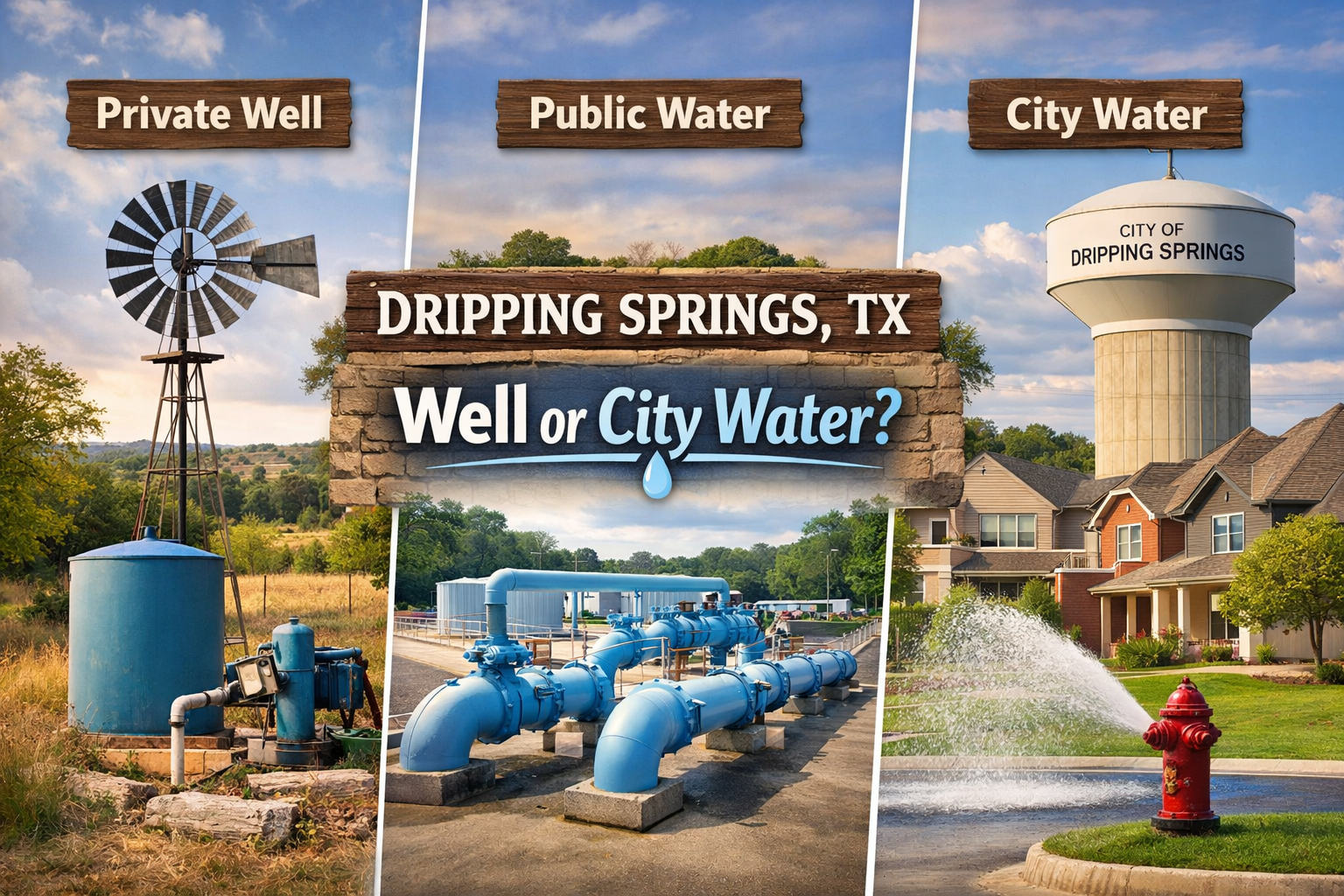
Water source in Dripping Springs often varies by address, not by mailing city. Buyers often underestimate how much the water setup affects costs, maintenance, and long-term livability, especially on acreage.
A common misconception is that “public water” automatically means City of Dripping Springs water. In practice, many homes are served by a water supply corporation, a MUD, or a private utility, and many acreage properties rely on private wells.
This topic is covered in deeper detail in a dedicated guide focused only on water source verification and what it means for a relocation decision. See the full breakdown here: Water source in Dripping Springs: wells vs city water.
Why flood risk surprises newcomers in Dripping Springs
Flood risk in Dripping Springs is not just a “river house” issue. What most newcomers miss is how localized drainage, low-water crossings, and upstream runoff can create problems even when a home feels far from a major river.
A common misconception is that being outside a mapped floodplain means there is no meaningful flood risk. That is not always true in Central Texas, where intense rain events can expose weak drainage, road access problems, and low-lying building sites.
This anchor guide only flags the decision risk. The deeper explanation, what to look for, and how buyers should verify exposure is covered here: Flood risk in Dripping Springs: what buyers need to understand before deciding.
The hidden cost reality behind property taxes in Dripping Springs
Property taxes are often the largest long-term “carrying cost” that changes the relocation decision. Dripping Springs living can feel affordable relative to other metros, but buyers often underestimate how tax rates, exemptions, and appraisal values combine.
A common misconception is that a lower purchase price automatically means lower taxes, or that exemptions apply automatically after closing. Tax outcomes vary by taxing entities, homestead status, and whether land is managed under an agricultural valuation where applicable.
This section stays high-level by design. For the full decision framework and verification steps, see: Property taxes in Dripping Springs: what buyers need to understand before deciding.
What utilities and infrastructure tell you about the true cost of Dripping Springs living
Utilities and infrastructure are the quiet drivers of long-term livability. The issue is not just monthly bills. It is also service reliability, provider coverage, and what happens when a property is outside standard utility networks.
A common misconception is that two homes five minutes apart will have the same utility experience. In this region, one home may have public wastewater while another has septic, and internet and electric providers can vary sharply by road and subdivision.
This anchor guide only flags the decision risk. The dedicated guide is here: Utilities and infrastructure in Dripping Springs: what buyers need to understand before deciding.
How insurance cost and availability can change the relocation decision
Insurance is not a fixed line item in Dripping Springs living. Cost and availability can vary based on roof age, prior claims, wildfire exposure, hail patterns, distance to fire protection, and property features.
A common misconception is that insurance is basically the same across Central Texas. Buyers often underestimate how replacement cost estimates, deductibles, and carrier appetite can affect both monthly cost and closing timelines.
This anchor guide is meant to highlight the decision risk. The deeper explanation and what to verify early is here: Insurance costs in Dripping Springs: what buyers need to understand before deciding.
Dripping Springs living is not a single “yes or no” decision. Long-term livability depends on address-level realities that online research often blurs. What most newcomers miss is that water source, flood exposure, property taxes, utilities, and insurance can each change the relocation decision even when the home looks perfect.
Authoritative sources to verify specifics include Hays County, the Hays Trinity Groundwater Conservation District, the Texas Water Development Board, FEMA Flood Maps, the Texas Department of Insurance, and the Hays Central Appraisal District.
If you want help pressure-testing a specific property in Dripping Springs, Driftwood, Wimberley, or nearby Hill Country areas before you commit, start here: https://chrispesek.com, or email chris@drippingspringshometeam.com, or call 512-736-1703, Chris Pesek is a Texas Hill Country Realtor specializing in land, acreage, and custom homes. 383+ sales. Top 2 Percent Producer. 63 five-star reviews., Texas Hill Country real estate, Central Texas real estate, San Antonio real estate, Dripping Springs TX homes, Driftwood TX homes, Wimberley TX homes, Hill Country land, Texas acreage, relocation to Central Texas