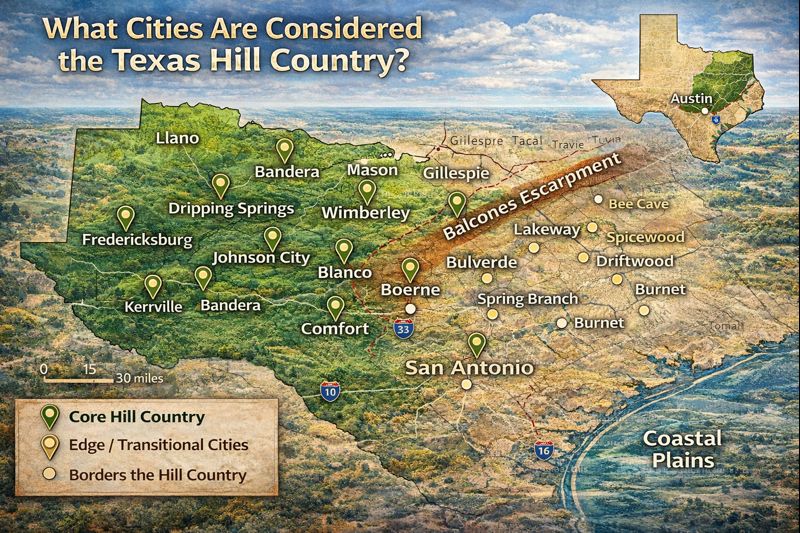
What Cities Are Considered the Texas Hill Country
The Texas Hill Country is not a city, county, or marketing label. It is a geographic region of Central Texas defined by limestone terrain, elevation change, shallow soils, and its position along the Balcones Escarpment. Cities are considered Hill Country based on land and geology, not ZIP codes or real estate branding.
This distinction matters because Hill Country cities share similar challenges and benefits that directly affect land use, home construction, water access, septic systems, and flood risk.
Core Texas Hill Country Cities
These cities are widely accepted as true Hill Country locations. They sit fully within the limestone hills and rolling terrain that define the region.
Dripping Springs, Wimberley, Fredericksburg, Blanco, Johnson City, Boerne, Kerrville, Bandera, Comfort, Llano, Marble Falls, Mason, Junction
These towns consistently show Hill Country characteristics such as rocky soils, elevation change, spring fed rivers, and limited large scale flat development.
Hill Country Edge and Transitional Cities
These cities are often grouped into the Hill Country, but conditions can vary depending on the exact location.
Bee Cave, Lakeway, Spicewood, Driftwood, Bulverde, Spring Branch, Burnet, Horseshoe Bay
Some neighborhoods in these cities feel fully Hill Country, while others transition toward flatter or more suburban terrain.
Cities That Border the Hill Country but Are Not Fully Inside It
Austin and San Antonio are not Hill Country cities as a whole, but they directly border the region.
Only western Austin and the north and northwest sides of San Antonio show true Hill Country terrain. Areas east of I-35 are generally flatter, clay based, and outside Hill Country geology.
Why Buyers Get This Wrong
Many buyers assume any town west of Austin or north of San Antonio automatically qualifies as Hill Country. That assumption leads to mistakes.
True Hill Country cities tend to share:
Limestone and karst geology
Shallow, rocky soils
Higher elevation and slopes
Septic and well systems outside city cores
Flash flooding from fast runoff
These factors affect:
Foundation design
Septic feasibility
Water sourcing
Floodplain exposure
Long term property usability
Two cities ten miles apart can feel completely different once you look below the surface.
Bottom Line
If the land rolls, rock is visible, and water moves fast during storms, you are likely in the Texas Hill Country. If the land is flat, heavily subdivided, and clay based, you probably are not, even if the name suggests otherwise.
Understanding which cities truly qualify helps buyers avoid expensive surprises and choose locations that actually match their goals.
If you want help confirming whether a specific city or property is genuinely Hill Country, visit https://chrispesek.com, email chris@drippingspringshometeam.com, or call 512-736-1703. Chris Pesek is a Texas Hill Country Realtor specializing in land, acreage, and custom homes.